
Introduction
Have you ever used Google to look for something and wondered why some websites show up at the top while others are way lower?
The main reason for this is Google’s search algorithm. Google uses special computer programs to find, understand, and rank billions of web pages.
When someone does a search, these programs help Google decide which results are the most helpful and useful for that particular search. For digital marketing students, it’s important to understand how the Google algorithm works because SEO, content marketing, website optimisation, and online visibility all depend on how search engines assess and evaluate websites.
In this guide, we’ll explain the Google algorithm in simple terms.
We’ll cover how it works, what affects rankings, and why it matters for digital marketing.
What Is the Google Algorithm?
Google organises data and chooses which search results to display for a user’s query using a collection of computer programs known as the Google algorithm. It’s not just one single formula. Google uses many different ranking systems and signals that work together to evaluate web pages. These systems look at things like relevance, content quality, links, and other signals based on the search being done.
For example, if someone searches for “best digital marketing courses”, Google tries to figure out what the person is looking for and finds pages that can give the most useful answer. The goal isn’t just to find pages with the most keywords.
Google wants to provide results that are helpful and relevant to users.
How Does Google Search Work?
There are three primary ways to comprehend Google Search.
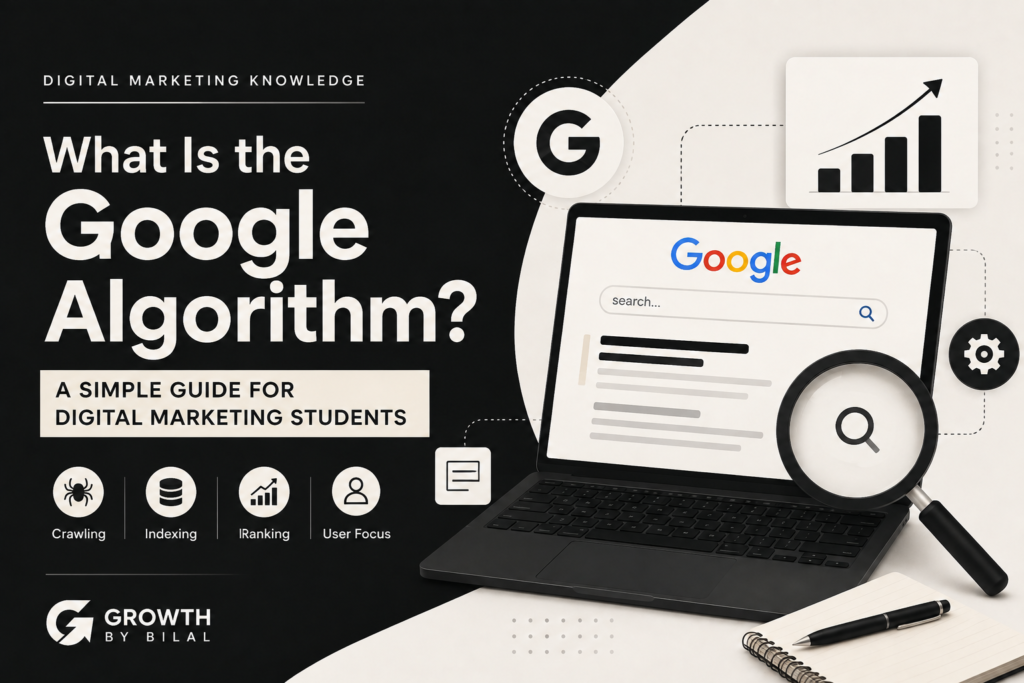
- Crawling
Crawling is the process of finding web pages. Google uses special programs called Googlebot to visit websites and discover new or updated pages.
Google can find pages through links, sitemaps, and other sources.
For instance, when you publish a new blog post on your website, Google might find it through your website’s sitemap or through links from other pages.
- Indexing
After finding a page, Google analyses its content and saves information about it in its search index. Google looks at the text, images, videos, title, and other details to understand what the page is about.
You can think of Google’s index like a huge digital library.
When someone searches for something, Google can look through this index instead of scanning the entire internet from scratch.
- Ranking
When a user enters a search query, Google’s ranking systems evaluate relevant pages and decide which results should appear. Different searches can give different results because the signals that matter can be different depending on the query.
For example, a search for “latest SEO trends” needs more up-to-date information than a basic search like “what is SEO?” Important Factors That Can Influence Rankings There’s no single list that guarantees a top position on the first page.
However, several areas are important for SEO.
- Search Intent
What a user seeks when they search is known as search intent. While someone searching for “SEO agency near me” might be looking for a service, someone searching for “what is SEO?” is seeking information. Understanding search intent helps marketers create content that matches what users really need.
- Helpful and Original Content
Google encourages creating content that is helpful, reliable, and user-focused. Your content should give real value rather than just repeating information from other websites.
Original explanations, useful examples, research, and practical insights can help make content more valuable for readers.
As a digital marketer, your main goal should be helping the audience, not just inserting keywords.
- Relevance
Google needs to understand whether your page is relevant to a particular search. Using clear headings, relevant terms, descriptive titles, and well-structured content can help both users and search engines understand your topic.
However, using too many keywords, known as keyword stuffing, is not a good SEO strategy.
- Website Experience
A website should be easy to use on different devices. Factors like mobile usability, page speed, accessibility, and overall page experience can affect how users interact with your website. Even if you have great content, it might not perform well if visitors find your website hard to use.
- Links
Links can help Google find pages and understand the relationship between different pieces of content. Google’s ranking systems include link-analysis systems such as PageRank. However, SEO should focus on earning relevant and trustworthy links instead of trying to manipulate rankings through artificial linking practices.
Why Is the Google Algorithm Important for Digital Marketing? Understanding Google’s ranking systems helps digital marketers make better SEO and content decisions. Instead of writing an article just because it has popular keywords, marketers should ask:
- What does my audience want to know?
- What problem does this content solve?
- Is the information accurate and useful?
- Is the website easy to use?
- Is the user’s search intent satisfied by the content?
Google also says there is no preferred word count for ranking.
So, writing a longer article does not automatically mean better SEO. The goal should be to create content that completely answers the user’s question without unnecessary information.
Common SEO Mistakes Beginners Should Avoid
Digital marketing students often make a few common mistakes when learning SEO.
Keyword stuffing: Repeating keywords too much instead of writing naturally.
Copying content: Publishing information that is simply copied from other websites.
Ignoring search intent: Creating content without understanding what the searcher actually needs.
Focusing only on rankings: Treating the number-one position as the only measure of success.
Using outdated techniques: Following old SEO tricks without checking current search engine guidelines.
Good SEO is not about trying to trick Google.
It’s about making useful information easier for people to find.
Frequently Asked Questions
Is Google using just one algorithm?
No. Google uses several different automated ranking systems and signals that work together to show the most relevant search results.
Does using more keywords help with rankings?
No. Keywords should be used in a natural way and in the right context. It’s more important to create helpful content than to repeat keywords.
Does longer content rank better?
Not always. Google doesn’t have a set word count they prefer. Content should be as detailed as needed to meet the user’s needs.
Can SEO guarantee the number one position on Google?
No. SEO can help improve your website’s visibility and search performance, but no one can guarantee that your site will be ranked first on Google.
Why do Google search results change?
Google keeps improving its search systems, and results can also change as websites update their content, add new pages, or as user needs change.
Conclusion
The Google algorithm might look complicated, but its main goal is simple: to help users find relevant, useful, and trustworthy information. For digital marketing students, understanding how Google crawls, indexes, ranks, and how search intent, content quality, links, and website experience affect search results is a good start for learning SEO.
Instead of chasing quick fixes or trying to trick the system, focus on creating valuable content and a website that really helps users. Successful SEO isn’t just about making content for Google. It’s about creating something valuable that people want to find, read, trust, and use.